Jehovah’s Witnesses, Blood Transfusions, and the Tort of Misrepresentation
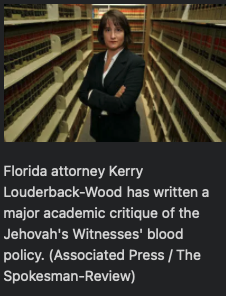
Kerry Louderback-wood is an attorney who lost her Jehovah’s Witness mother because she chose not to accept a life-saving blood transfusion. Kerry sought to do research in the primary booklet used to explain the JWorg policy on the reasons medically they do not accept blood transfusions. It was called “Jehovah’s Witnesses and the Question of Blood”. Was the information founded on facts or fraud?

The booklet used to enforce JW blood policy
Jehovah’s have a history of declaring blood transfusions to be an abomination to God and worthy of eternal damnation.
Below is the chronological timeline of how the Governing Body has formulated, enforced, and adjusted its directives on blood and medical treatments:
Early Era: No Restrictions (Before 1945) 1921–1952: The Watch Tower Society campaigned against and banned vaccinations, viewing them as a violation of God’s law. During this era, there were no restrictions on blood transfusions.
The Prohibition and Enforcement (1945–1961)
July 1945: The Watchtower officially banned blood transfusions and primary blood products, declaring them "pagan and God-dishonoring" based on interpretations of biblical verses commanding believers to "abstain from blood" (such as Acts 15:29).
1961: The policy shifted from a moral guideline to a strictly enforced law. The church introduced the penalty of disfellowshipping (expulsion and shunning) for any unrepentant member who willfully accepted a blood transfusion.
The Introduction of "Fractions" and Conscience (1960s–2000)
1963–1964: The policy fluctuated rapidly.
In 1963, blood serums were prohibited.
Only 21 months later, in late 1964, the policy reversed to allow blood serums. Rules were also extended to prohibit blood transfusions for pets or using fertilizer containing blood.
1966: The Watchtower explicitly described receiving a blood transfusion as a form of cannibalism.
2000: A major restructuring occurred regarding "minor fractions." While whole blood and its four primary components (red cells, white cells, platelets, and plasma) remained strictly forbidden, members were permitted to use their individual conscience to accept minor blood fractions (such as albumin, immunoglobulins, or clotting factors).
The Recent Landmark Reversals (2026)
In 2026, the Governing Body instituted the most sweeping changes to the blood doctrine since the original 1945 ban, transitioning many long-held prohibitions into matters of personal choice.
March 20, 2026: The organization revised its policy regarding a patient’s own blood. Preoperative collection, storage, and subsequent reinfusion of a patient's own blood (autologous transfusion)—which had previously strictly forbidden—became a matter of individual conscience.
September 18, 2026: In a monumental announcement, the Governing Body ruled that accepting the four major components of blood (red blood cells, white blood cells, plasma, and platelets) from another person is now a matter of individual conscience. Members are also permitted to donate blood if it is intended for the production of these components or fractions.
Current Standing: The traditional ban on transfusing whole blood remains unchanged. However, local congregations have been explicitly instructed not to judge, interfere with, or disciplinary sanction members who choose to accept or donate any of the four primary components.
See the history below:
Due to the First Amendment of the United States, religion is allowed to practice whatever belief they wish, even if it kills their members. As an attorney, Kerry was aware of this guideline. Some religions refuse all medical treatment with medicines to the detriment of their members. These practices are protected by the U.S. Constitution and would never provide a basis for litigation. For Kerry, the questions remained: what if these practices were taught to members based on fraud and lies? Could that be a basis to sue a religion that knowingly enforced a policy that killed its members, whom they knew had followed a fabricated medical foundation?
Kerry wrote the following article that exposed the vast amount of fraud and lies found in the “Blood” booklet.
With the recent adjustments in Jehovah’s Witness policy, it opens the possibility of litigation based on the fact that all the members died believing the lies they were told in the publications of Jehovah’s Witnesses to refuse blood and die with the conviction that it was a good medical decision.
It was not.
Blood transfusions are generally safe, with minor adverse reactions occurring in about 1% to 10% of procedures and serious complications happening in less than 0.5% of cases.
Risks are far higher with most medications or treatments. For those reasons, even though Jehovah’s Witnesses as a religion are protected to kill their members under the First Amendment protection of religious practices, they are not entitled to murder their members based on false medical information used to trick them into making bad medical decisions.
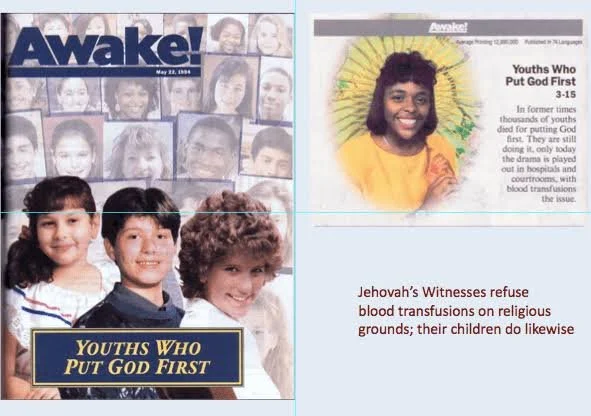
Children who died not accepting blood
When you consider the hundreds of Jehovah’s Witness children who have died believing misrepresented medical risks and how these dead children were held up as martyrs by leadership, it should be considered a criminal act.

The decision makers of life and death
Kerry Louderback-wood lays a strong legal foundation that the Governing Body of Jehovah’s Witnesses should be held accountable for their crimes against humanity.